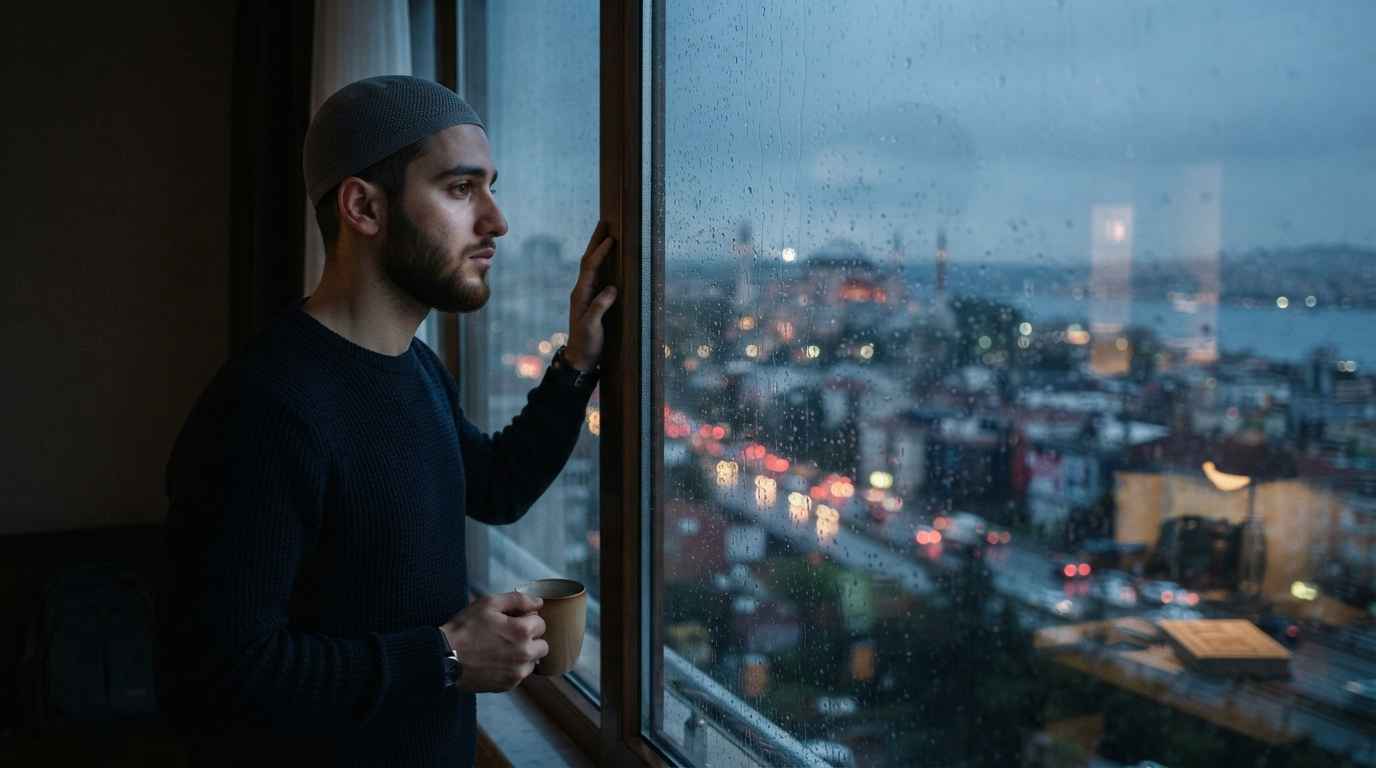
Key Takeaways
- What It Is: Being Muslim in a new country adds islamophobia and discrimination to normal resettlement stress.
- Accumulation: Small moments build up, not one dramatic event.
- Double Load: Resettlement strain plus being treated as suspect for your faith.
- The Data: Rising anti-Muslim incidents link to poorer mental health in the US and UK.
- Common Responses: Hypervigilance, self-editing, withdrawal, identity conflict. Reactions, not failings.
- Faith And Therapy: The two work together. Sabr means enduring with patience, and reaching out for support.
Quick answer Living as a Muslim in a new country often means managing culture shock and religious discrimination at the same time. Over months and years, that pressure can show up as anxiety, low mood, hypervigilance, and a pull to hide your identity. Talking to someone who understands your faith, and staying close to your community, makes it easier to carry. |
Moving countries is already one of the biggest stressors a person can go through.
Doing it as a Muslim, in a climate where anti-Muslim sentiment is rising in several Western countries, adds a layer that friends back home may not fully understand and that new neighbors may not see at all.
This article names that layer honestly, explains what it does to your mental health, and offers practical ways to protect yourself and your family.
What Islamophobia Looks Like When You Have Just Arrived
Most people picture Islamophobia as violence or open abuse.
That does happen, and it matters. But for the majority of Muslims settling into a new country, discrimination is quieter and more constant.
In the UK, Tell MAMA recorded 6,313 anti-Muslim cases in 2024, up from 4,406 the previous year, with a sharp rise in in-person incidents in streets, parks, and workplaces.
In the US, the Institute for Social Policy and Understanding found in 2025 that Muslims report higher levels of religious discrimination than other faith communities, and describes Islamophobia as a structural determinant of Muslim mental health.
Why the First Few Years Hit Hardest
Discrimination is harder to absorb when almost everything else in your life is also new.
Back home, you had context.
You knew which offices to avoid, which relative to call, what a rude tone actually meant in your culture.
Abroad, you lose that instinct.
When something goes wrong, you cannot always tell whether you were treated badly because of your faith, because of your accent, because you are new, or because the person was simply having a bad day.
That ambiguity is exhausting in its own right.
Many people spend enormous mental energy replaying interactions, trying to decide whether they are being oversensitive.
At the same time, the buffers that used to protect you are gone or thinned out.
Extended family is in another time zone. The mosque you grew up in is replaced by one you have not yet found. Professional credentials may not transfer.
Your social standing may have quietly reset to zero.
Loneliness and financial pressure are already high, and discrimination lands on top of that rather than instead of it.
The demographic picture reflects this. ISPU reports that 40% of Muslims in the United States were born outside the country, and that Muslims are the faith group most likely to have a household income of $30,000 or lower (ISPU, 2026).
Immigration status, financial strain, and religious discrimination often stack on the same person at the same time.
What Chronic Discrimination Does to Your Mental Health
Researchers use the term minority stress to describe the cumulative burden carried by people who belong to a stigmatized group.
It is not the same as ordinary stress.
Ordinary stress has a beginning and an end.
Minority stress has no obvious off switch, because the thing being targeted is not something you did. It is who you are.
In practice, people describe some recurring patterns:
- Scanning rooms, reading faces, sitting where you can see the exit. Your nervous system stays switched on long after the incident has passed.
- Anticipatory anxiety. Dreading the school run, the commute, the family gathering where someone will make a comment.
- Self-editing. Softening your accent, avoiding Arabic in public, praying in the car rather than asking for a room, letting people mispronounce your name because correcting them feels like too much.
- Declining invitations, skipping the gym, staying home. The world gets smaller because a smaller world feels safer.
- Identity conflict. Feeling too foreign for your new country and too changed for the one you left. Young people and second-generation children often feel this most acutely.
- Guilt and internalized doubt. Wondering whether you brought your family somewhere that will not accept them, or whether you are simply not resilient enough.
These are not signs of weakness.
Public health research has argued for years that Islamophobia should be understood as a determinant of health rather than a purely political matter (American Journal of Public Health).
If your body is responding as though it is under threat, that is because, at times, it is.
The mental health data tracks with this.
More than one in five Muslims in the US rate their mental health as fair or poor, higher than the general public, and among Muslims aged 18 to 29 that figure rises to 33% (ISPU, 2026).
If you have felt like something has shifted in you since arriving, you are not imagining it. Some of what you are carrying is described elsewhere on our blog in how global events affect Muslim mental health.
Why So Many Newcomers Stay Quiet About It
There are reasons people do not talk about this, and most of them are understandable.
There is the fear of seeming ungrateful. You fought hard to get here.
Family back home talk about your new life as a success story.
Saying that you feel unwelcome can feel like a betrayal of everyone who prayed for this.
There is the fear of consequences.
If your status depends on a visa, an employer, or a sponsor, complaining feels dangerous even when it is legitimate.
There is the belief that this is simply the price of migration, something to be endured quietly.
And there is stigma around therapy itself, which we cover in detail in our article on why Muslims avoid seeking mental health support.
Muslims in the US remain less likely than the general public to have ever seen a mental health professional, at 32% compared with 38%, although that number has been rising steadily since 2019.
Silence protects you in the short term.
Over years, it usually costs more than it saves.
Practical Ways to Protect Your Wellbeing
You cannot single-handedly fix the climate you moved into. You can change how much of it you absorb.
Name what happened, out loud, to someone
The most corrosive part of everyday discrimination is the doubt it creates.
Telling one trusted person, on the same day, breaks that loop. You are not building a legal case. You are refusing to carry it alone.
Keep a private record
If incidents happen at work, in housing, or at your child's school, write down the date, what was said, and who was present.
This serves two purposes: it gives you options if you ever choose to escalate, and it stops you from later minimizing what happened.
Rebuild community deliberately
Belonging does not reassemble itself. Find the local masjid even if the culture feels different from home.
Look for halaqas, sports leagues, parent groups, or community organizations.
Research on Muslim communities consistently finds that connection is one of the strongest protective factors available.
Set boundaries around the news
Staying informed matters. Refreshing coverage at midnight does not.
Choose set times to catch up and protect the hours before sleep.
Support your children without transferring your fear
Children absorb far more than parents realize.
Ask specific questions rather than general ones, so instead of asking whether school was fine, ask who they sat with at lunch.
Tell them plainly that what happened was wrong and not their fault.
Then take it to the school in writing. Children need to see an adult respond, not just an adult worry.
Protect the basics
Sleep, movement, food, and prayer times are not luxuries during a stressful season.
They are the foundation that everything else rests on. When these slip, everything else feels heavier.
Where Faith Fits Into This
Many Muslims are told, with genuine kindness, to have sabr. The advice is sound. It is also often misheard.
Sabr is not passivity, and it is not silence. It is steadfastness while you continue to act.
The Prophet, peace be upon him, and the early Muslim community faced hostility, and their response included patience, seeking counsel, community support, and, when needed, migration to safety.
None of that involved pretending the harm was not happening.
Tawakkul works the same way. You tie your camel and then you trust.
Seeking treatment for your mental health is the tying of the camel. It is not a substitute for dua, and dua is not a substitute for it. Both belong.
If your faith feels harder to hold right now, or if prayer has started to feel heavy rather than steadying, that is worth taking seriously rather than judging yourself for.
Spiritual fatigue is often one of the earliest signals that a person is depleted.
When to Speak to a Therapist
Consider reaching out if you notice any of the following continuing for more than a few weeks:
- Anxiety that no longer switches off, or dread attached to ordinary places like work, school, or public transport.
- Sleep problems, appetite changes, or persistent low mood that lifts only briefly.
- Avoiding places you used to go, or shrinking your life to feel safe.
- Irritability or anger at home that does not match the situation in front of you.
- Replaying incidents, intrusive images, or a sense of being permanently on alert.
- Hiding your faith in ways that leave you feeling ashamed rather than safe.
A therapist who shares your frame of reference makes a meaningful difference here.
You should not have to spend the first three sessions explaining what Jummah is, why your mother's opinion carries weight, or why leaving your faith is not the solution to the discrimination you face.
Shifa Therapy connects Muslims with licensed, verified Muslim therapists for online video sessions in English, Arabic, Urdu, and other languages, with support available for anxiety and stress, trauma, and depression.
Sessions are completely private and no one in your family, workplace, or community is notified.
Frequently Asked Questions
Is it normal to feel anxious in public as a visibly Muslim person?
Yes, if you've been stared at or insulted before. Address it when it starts shaping decisions, like skipping work events or dressing differently to feel safe.
Should I report Islamophobic incidents?
Yes, if you want to. Reporting brings accountability but can be draining. Many people document privately first and decide later.
Can therapy help when the problem is discrimination rather than something inside me?
Yes. Therapy treats it as real, and helps you process it, ease the stress toll, and decide how to respond. The problem stays external. What changes is what it costs you.
My therapist is not Muslim. Will they understand?
Some are non-Muslim therapists are genuinely skilled. If your faith gets treated as part of the problem, find a better fit.
My child is being bullied at school because of our faith. What should I do?
Act early. Tell them it wasn't their fault, raise it with the school in writing. If they withdraw or show shame, a therapist who knows Muslim families can help.
Will things get easier over time?
Often, yes. What builds fastest is your support system and your ability to recognize what's happening without absorbing it.
Therapists who specialize in this
We couldn't load therapists right now.
Looking for Support?
Connect with a licensed therapist specialized in these areas.



Ready to Start Your Therapy Journey?
Connect with a licensed therapist who understands your needs — fully online and confidential.