Key Takeaways
- What it is: Infertility grief is real loss, made heavier by having no funeral to mark it.
- How common it is: Roughly one in six adults worldwide experience infertility.
- Often unspoken: Male factor causes over half of all cases, yet stays the least discussed.
- Faith and longing: Wanting a child and trusting Allah are not opposites. Prophets asked for children openly, for years.
- What helps: Psychological support eases the distress, and couples work protects the marriage.
Quick answer
Infertility grief is real grief, even though nothing visible has been lost.
Muslim couples often carry it alongside community questions, secrecy, and the fear that sadness means weak faith. It does not.
Faith-aligned therapy helps couples process the loss, protect the marriage, and make treatment decisions without shame.
The grief no one talks about
It usually starts at a gathering. Someone leans in, smiles warmly, and asks when the good news is coming.
You laugh. Your spouse laughs.
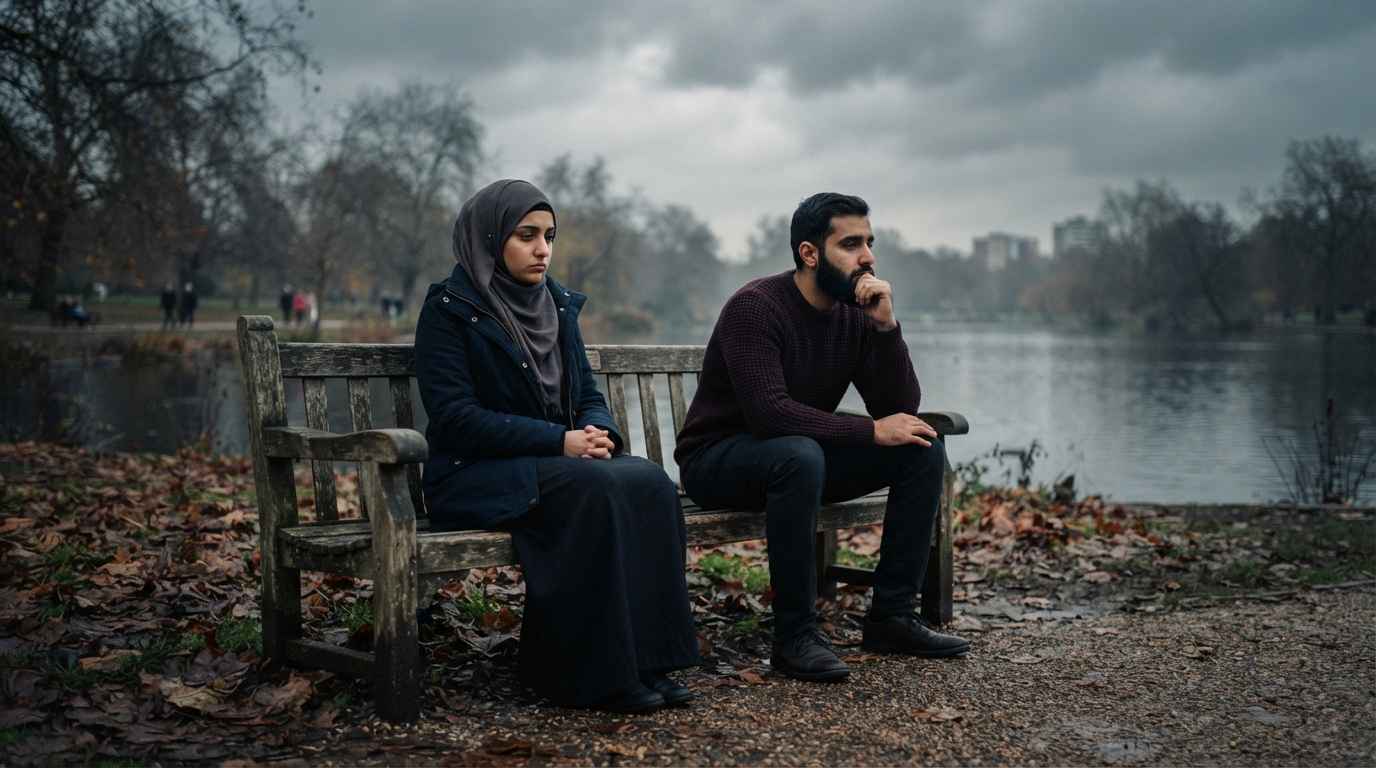
Then you drive home in a silence that has become familiar, and one of you cries later with the tap running so the other one does not hear.
Couples who are trying to conceive become experts in that particular silence.
Every month contains a small rise of hope and a private collapse, and neither of those gets spoken about at the dinner table.
There is no janazah, no condolence line, no one bringing food to the house. Nothing has visibly been lost, so nothing is formally mourned.
Clinicians have a name for this. Disenfranchised grief describes loss that is not socially recognized or validated, which leaves the person grieving without the rituals and support that usually surround mourning.
Infertility sits squarely in that category. So does recurrent miscarriage, a failed cycle, an ectopic pregnancy, a chemical pregnancy that only you and your spouse knew existed.
There is a second layer that makes it harder still. Infertility is also an ambiguous loss, a loss without an ending, because next month could always be different.
You cannot fully grieve, because grieving feels like giving up. You cannot fully hope, because hope has already hurt you several times.
Most couples live in that narrow space between the two for years, and they are usually doing it while smiling at aqiqahs.
If you have been telling yourself you are overreacting, the research does not agree with you.
What the evidence actually says about infertility and mental health
You are not an unusual case. According to the World Health Organization, around 17.5% of the adult population, roughly one in six people worldwide, experience infertility during their lifetime.
The rates are broadly comparable across high, middle and low income countries.
Whatever your community assumes about who this happens to, it happens everywhere and to everyone.
Distress also travels between spouses.
A study of 1,247 couples undergoing fertility treatment found that each partner’s anxiety and depression scores were significantly correlated with the other’s.
In practice this means what most couples already sense: you are not two people having separate reactions. You are one system, and when one of you sinks, the other feels the water rise.
When "it is qadr" lands like a door closing
Most Muslim couples in this situation have been handed the same three sentences. It is Allah’s will. Just make dua. Maybe you are not ready yet.
Every one of those can be true and still be delivered in a way that shuts a grieving person down.
Tawakkul was never meant to function as a gag order.
Trust in Allah and open longing for something sit together throughout the Qur’an, and nowhere more clearly than in the stories of people who waited decades.
Prophet Zakariya, peace be upon him, asked his Lord not to leave him alone, naming Allah as "the best of inheritors" (Surah Al-Anbiya 21:89).
He made that dua quietly, in old age, after a long wait, and the following verse records that it was answered.
What matters for a couple still in the waiting is not only the answer.
It is that the ache was voiced at all, by a prophet, and was never treated as evidence of weak faith.
There is a line worth drawing clearly here.
Questions of religious ruling, including what fertility treatments are permissible and under what conditions, belong with a qualified scholar who can look at your specific situation. Those rulings are not the work of a therapist.
The emotional weight of carrying those decisions, the disagreement they can cause between spouses, the guilt afterward, the exhaustion of researching them while grieving, that is exactly the work of a therapist.
It does not land the same way on both of you
Grief also expresses itself differently between partners.
One of you may need to talk about it repeatedly, because talking is how the feeling gets metabolized.
The other may go quiet and practical, researching clinics, taking on extra work to cover costs, managing appointments.
Neither response is coldness and neither is weakness. Problems begin when each partner reads the other’s coping style as proof they care less.
Women in this position also carry a public dimension men usually do not.
She is the one asked at every walima. She is the one whose body is discussed.
She is the one who hears about a cousin’s pregnancy first, and who is expected to be delighted immediately.
What years of trying does to a marriage
The strain is rarely dramatic. It is cumulative, and it shows up in ordinary places.
- Decision fatigue sets in. How many cycles. How much money. Which clinic. When to stop. These conversations repeat for years without resolution and often surface at the worst possible hour of the night.
- Money becomes emotional. Treatment is largely paid out of pocket in most countries, and the financial pressure attaches itself to every disagreement you have about anything else.
- Avoidance grows. You skip the aqiqah. You leave the baby shower early. Then you feel guilty for skipping, and the guilt makes the next invitation harder.
- Blame surfaces indirectly. Rarely as an accusation. Usually as a tone, a withdrawal, or a comment about a family history that lands harder than it was meant to.
None of this means the marriage is failing. It means the marriage is carrying something heavy without being given tools. This is precisely the territory Muslim marriage counseling is built for, and couples who come in early tend to protect far more than couples who come in after a year of not talking.
What therapy actually does for infertility grief
Therapy is not a fertility treatment. In practice, sessions tend to cover a predictable set of ground:
- Naming the loss properly, so that grief which has been called overreaction for years finally gets treated as grief.
- Separating self-worth from outcome, particularly for the partner who has begun to describe themselves as broken or as a failure to their family.
- Working with uncertainty rather than fighting it, which is where acceptance and commitment approaches are especially useful during long treatment timelines.
- Interrupting the pursue and withdraw cycle in the marriage, so that one partner’s need to talk stops triggering the other’s need to shut down.
- Building actual language for family boundaries, rehearsed in session, so you are not improvising at a wedding.
- Processing trauma where there has been pregnancy loss, an emergency procedure, or a distressing experience in a clinic.
There is also something specific about doing this with a Muslim therapist. You will not have to explain why the questions at gatherings matter, why your mother-in-law’s opinion carries weight, or why "just adopt" is not a simple sentence in an Islamic family context.
Muslim grief counseling sessions start from that shared ground rather than spending the first three sessions building it.
Six things you can put in place this week
- Agree one sentence for the question, and both use it: Something like: we are not sharing updates on that, but we appreciate you thinking of us. Having it ready removes the panic of being asked.
- Decide together who knows what: Secrecy is exhausting and full disclosure is exposing. Choose two or three people deliberately rather than defaulting to either extreme.
- Protect one day a week where fertility is not discussed at all: No appointments, no research, no forums. Couples consistently report this is harder than it sounds and worth more than they expected.
- Mark the losses in some way: A quiet dua together, sadaqah given for what you hoped for, a walk you take after every negative result. Grief that has a container is easier to carry than grief that has none.
- Split the logistics: Where the medical burden falls on one body, the administrative burden should not fall there too.
- Set a review point for treatment decisions in advance: Deciding how many cycles you will attempt before pausing is far kinder than deciding it at two in the morning after bad news.
When it is time to reach out
Consider speaking to a professional if you notice any of the following in yourself or your spouse.
- Low mood, flatness or tearfulness on most days for two weeks or longer.
- Dread or physical anxiety before scans, results or family gatherings.
- Hopelessness, or the sense that your life has stopped until this resolves.
- Arguments escalating faster than they used to, or long stretches of not speaking.
- Complete avoidance of intimacy, or of the people you used to be close to.
- Using alcohol, food or overwork to get through the weeks between attempts.
Frequently Asked Questions
Is it wrong to feel this sad if I believe in qadr?
No. Accepting the decree of Allah has never required feeling nothing about it. Prophets grieved openly, asked for what they wanted, and wept. Believing that Allah is in control and being heartbroken by the wait are two separate things happening at the same time, and one does not cancel the other. Suppressing grief tends to prolong it rather than resolve it.
Is IVF permitted in Islam?
That is a question for a qualified scholar who can consider your specific circumstances, and scholarly positions differ on aspects of it, particularly anything involving a third party. What we can help with is everything that surrounds the decision: the disagreement it can create between spouses, the guilt, the pressure from family, and the emotional cost of going through treatment cycles.
Should we come to therapy together or separately?
Both work, and many couples do both at different stages. Couples sessions are useful when communication has broken down, when intimacy has become difficult, or when you are stuck on treatment decisions. Individual sessions suit a partner carrying a diagnosis privately, or one who needs space to grieve without managing their spouse’s reaction at the same time.
How do I answer relatives who keep asking when we will have children?
Prepare one short sentence in advance and use it every time, without explaining further. Something like: we are not sharing updates on that, but thank you for thinking of us. It works because it is polite, closed, and repeatable. Rehearsing it with a therapist first makes it far easier to deliver when you are caught off guard.
Can therapy improve our chances of conceiving?
Research on that question is mixed, and we would not want you to book on that basis. What therapy does reliably support is your mental health, your marriage and your capacity to keep making decisions through a long and uncertain process. Those are worthwhile outcomes on their own, whatever happens with treatment.
Therapists who specialize in this
We couldn't load therapists right now.
Looking for Support?
Connect with a licensed therapist specialized in these areas.




Ready to Start Your Therapy Journey?
Connect with a licensed therapist who understands your needs — fully online and confidential.